
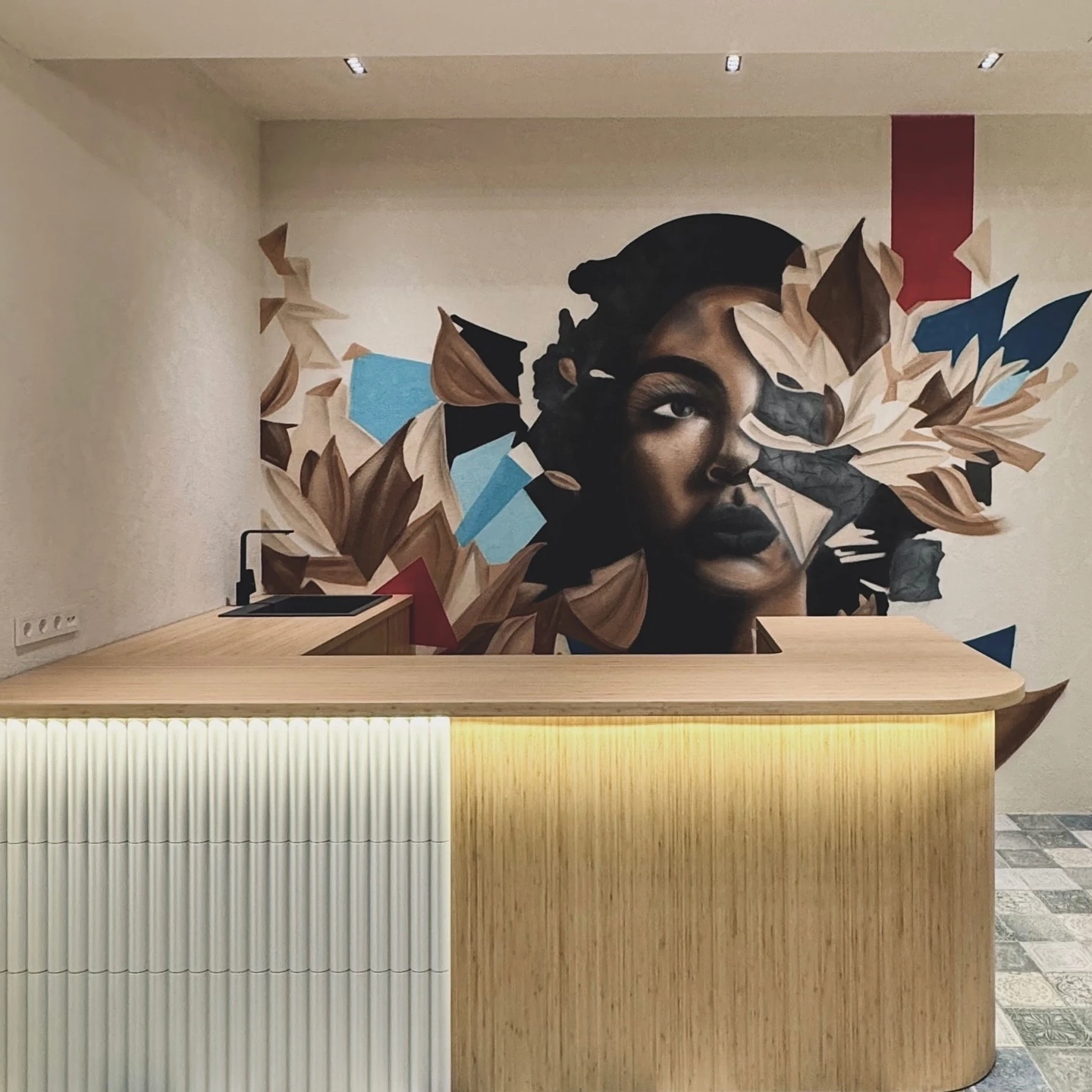
When choosing artwork for a café or restaurant wall, the first question is often what to paint. Yet the wall’s location, lighting and relationship with the rest of the space matter just as much as the subject.
You may be searching for graffiti, murals or wall art. To find an approach that suits your project, start by clarifying the atmosphere you want to create and the conditions in which the work will be carried out.
What is the difference between graffiti and a mural?
You may encounter “grafiti” in Turkish and “graffiti” internationally. Graffiti is a broad form of expression that can include lettering, typography, characters and other visual narratives. A mural is a painting created on an architectural surface; in Turkish, it is commonly described as a “duvar resmi”, or wall painting.
These approaches can overlap. A mural may incorporate lettering or techniques associated with graffiti. Rather than choosing by terminology alone, it is more useful to discuss examples you like and what you expect from the space.
Where should you start when choosing a café mural?
Begin by describing the character of your venue. A quiet meeting place, a lively coffee spot and a restaurant with a strong brand story may call for different visual choices. The same portrait, colours or lettering style will not suit every business.
The role of the wall also needs to be defined. Should it attract attention at the entrance, accompany the seating area or tell the brand’s story? This helps establish whether the composition should be a strong focal point or a quieter presence.
How should you assess portraits, typography and abstract designs?
Portraits and illustration
A portrait or illustration can create a distinct visual narrative. Consider the subject’s relationship with the venue and brand, its scale and how it works with surrounding elements. Rights to use any source imagery should also be clarified during design development.
Lettering and typography
A brand name, a phrase or an original lettering composition can become the centre of a design. Think about the distance from which it will be read and its relationship with existing menus and signage. Instead of treating the wall simply as a place to enlarge a logo, discuss the overall visual composition.
Abstract and geometric compositions
Abstract forms and geometric arrangements can emphasise colour and movement. They still need to respond to their setting: the composition should be designed in relation to existing materials and viewing angles.
How do dimensions, lighting and furniture affect the design?
Viewing a sketch on its own is different from assessing it in the venue. Seating, shelves, counters and light fittings may conceal parts of the work or draw attention to particular areas.
The view from the entrance may differ from what someone sees while seated at a table. It is therefore useful to share photographs showing the wall in its surroundings, as well as close-up views.
Daylight and artificial lighting can affect how colours are perceived. Considering materials and colours together helps adapt the design to its setting.
What approaches were used in actual projects?
For Pizza Sapore’s portrait mural, the venue’s warm material palette was one of the starting points for the composition. Layered forms and colour accents around the portrait were considered in relation to the wooden surfaces.
At Ayaküstü Kahve, vivid colours and free-flowing lines accompanied a black-and-white portrait. The height of the wall and the daylight were part of the composition’s context.
These examples illustrate the value of developing a design for a particular setting rather than recommending the same treatment to every business. They do not establish claims about increased customer numbers or sales.
What should be checked before painting the surface?
The initial assessment should include the wall’s texture, existing finish and any signs of cracking or flaking. A photograph may not reveal the cause of every surface problem; an on-site review or an assessment by a relevant specialist may be needed.
Before a quote is prepared, discuss who will prepare the surface, how nearby furnishings will be protected and how the working area can be accessed. Techniques and materials should be chosen according to the project’s actual needs.
What should you share if you are working with an architect or interior designer?
You can share plans, wall elevations, the material palette and lighting decisions. Considering the mural alongside this information helps coordinate it with other elements of the project.
Graffiti Ankara can collaborate with architects and interior designers on artwork, rather than providing an interior architecture service. It is useful to identify the project team and decision-making process in the first conversation.
How does an initial mural assessment begin?
Start with the city and district, approximate wall width and height, a few photographs, your intended schedule and any examples you like. If you do not yet have a specific idea, describe how the venue is used and the atmosphere you want to create.
Graffiti Ankara is based in Ankara. Projects outside Ankara are assessed according to their scope and site conditions. The design and production scope is clarified during the initial discussion.
Share photographs and approximate dimensions of your wall so we can consider an approach suited to your café or restaurant.