
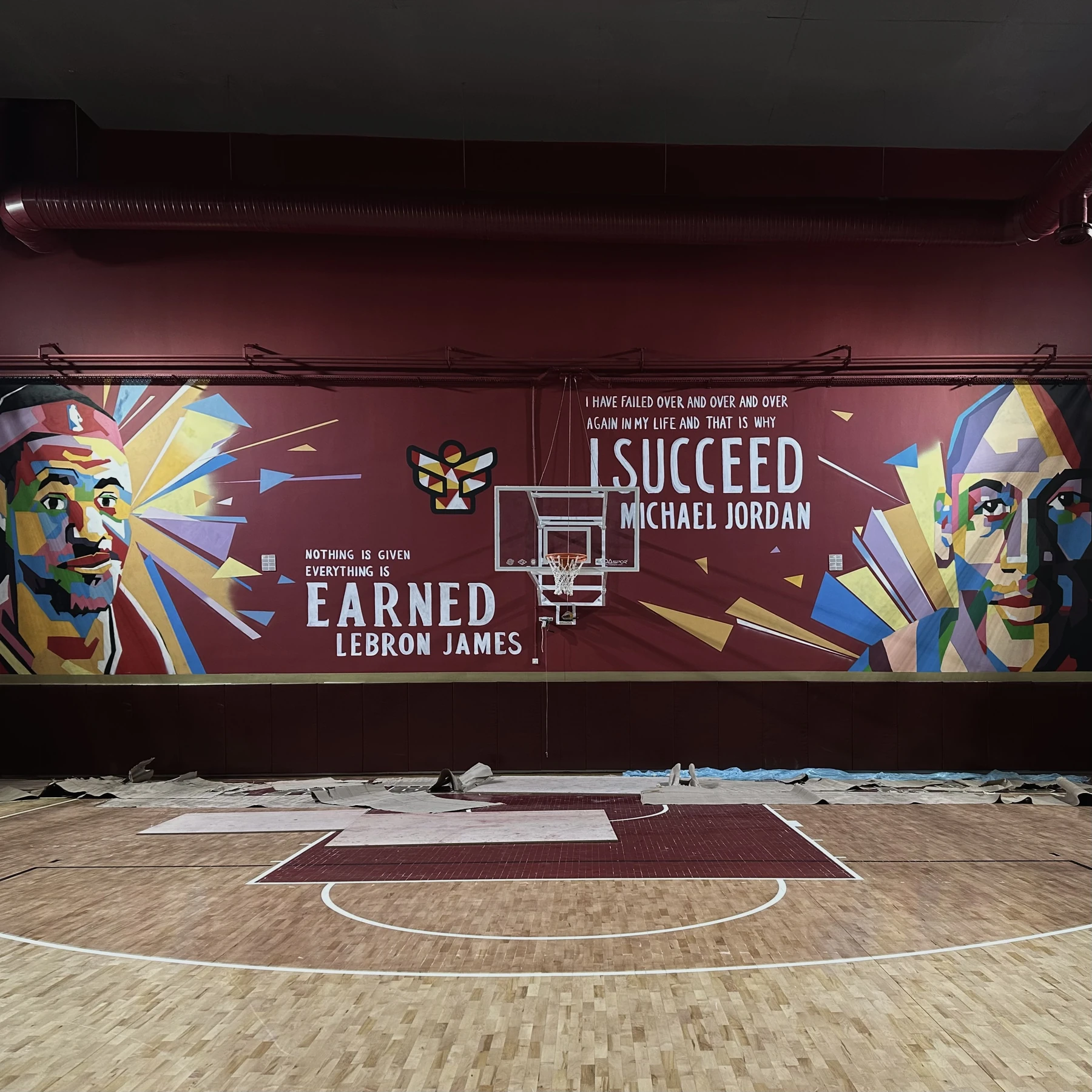
If you are considering artwork for a schoolyard wall, the perimeter of a basketball court or the entrance to a sports hall, choosing a figure to paint is only one decision. Who uses the area, where the work will be seen from and how it relates to existing signage also shape the design.
When planning a school mural or graffiti project for a sports area, consider the theme, scale and working conditions together. Start by describing how the space is used so that visual options can be assessed in context.
How should you choose a theme for a school mural?
Different age groups and areas may call for different visual languages. A play area in a nursery school, a secondary-school courtyard and a sports hall need not use the same approach.
Nature, science, art and sport can provide starting points. Theme selection should go beyond a subject label, however. Discuss the institution’s approach, students’ ages and the wall’s relationship with its surroundings.
Clarify whether the work should accompany wayfinding, identify an area or establish a shared visual narrative. It should not promise unmeasured improvements in achievement, motivation or learning.
How should composition be approached in a basketball court or sports hall?
A sports-area wall may be seen from different distances and while people are moving. Details that are clear up close may not be perceived in the same way from the far end of a court.
Viewing distance and scale
When defining the main elements, assess the views from the court, entrance and any spectator area. The scale of portraits, geometric forms or lettering can respond to these viewpoints.
There is no need to fill the entire wall with detail. Negative space and visual density should be considered alongside the movement around the area.
Existing signage and equipment
Locate scoreboards, wayfinding, emergency-exit signs, doors and sports equipment before developing the design. The artwork should not obstruct their visibility or use.
A wall mural should not be treated as the same service as painting a sports floor or court markings. Floor surfaces involve separate material, use and technical conditions; any such request needs its own defined scope.
Does school graffiti have to consist only of lettering?
Lettering is often the first association with graffiti, but characters, portraits and other visual narratives may also be considered, depending on the approach. Some projects overlap with work described as murals or wall paintings.
If the school’s name, a message or typography is required, legibility and approval of the text matter. Rights to use a popular character, logo or another artist’s work should also be clarified. Sharing a reference image does not establish permission to reproduce it exactly.
What should be checked on interior and exterior surfaces?
Approximate dimensions, overall photographs and close-up images are useful for the initial assessment. Share any signs of cracking, flaking or damp, as well as information about previous finishes.
Photographs may not reveal the cause of every surface problem. An on-site review or assessment by a relevant specialist may be needed. Responsibility for preparation and repairs should be agreed before work begins.
Weather can affect outdoor scheduling, while indoor work needs to account for daily use and preparation of the working area. Materials and application decisions should respond to the actual condition of the surface.
What approach was used for Anka Bilim Koleji’s basketball court mural?
In Graffiti Ankara’s mural for Anka Bilim Koleji’s basketball court, the energy of sport was interpreted through geometric portraits and vivid colours. Sharp lines, rhythmic forms and typographic accents were parts of the composition.
The work shows that a sports theme need not be limited to a ball or court motif. Another school may call for a different visual language, according to its age groups, institutional approach and the characteristics of the area.
How can the work fit into the school’s timetable?
Do not commit to a duration before design approvals, surface preparation and access conditions are clear. Lessons, training sessions, events and maintenance should be included in planning.
The institution and production team should agree how to separate the working area from users and when it can reopen, taking the requirements of the products used into account. Avoid assuming a single waiting period applies to every project.
How do you request a quote for a school or sports-area mural?
Prepare the following for an initial discussion:
- The city and district of the school or sports area.
- Approximate wall width and height.
- Photographs of the surface and its surroundings.
- The users’ age groups and the purpose of the area.
- Your intended theme and any institutional visual guidelines.
- The target period for the work and availability of the area.
If an architect or interior designer is involved, plans, elevations and material decisions can also be shared. The artwork can then be assessed in coordination with the existing project team.
Graffiti Ankara is based in Ankara. School and sports-area projects outside Ankara are assessed according to their scope and site conditions.
Tell us about your school or sports-area project. Send the wall photographs, approximate dimensions and location to Graffiti Ankara via WhatsApp.